Sponsored article
Evolution of the Roman Chasuble and Its Regional Variations
- Regional Variations of the Roman Cut and Their Symbolism
- Practical Examples and Fabric Care
- FAQ
- What distinguishes a Roman chasuble?
- Is the Roman chasuble older than the Gothic chasuble?
- When are Roman chasubles most commonly used?
- What decorations are most common on Roman chasubles?
- Is the Roman chasuble permitted under current liturgical regulations?
- What is the main difference between Roman and Gothic chasubles?
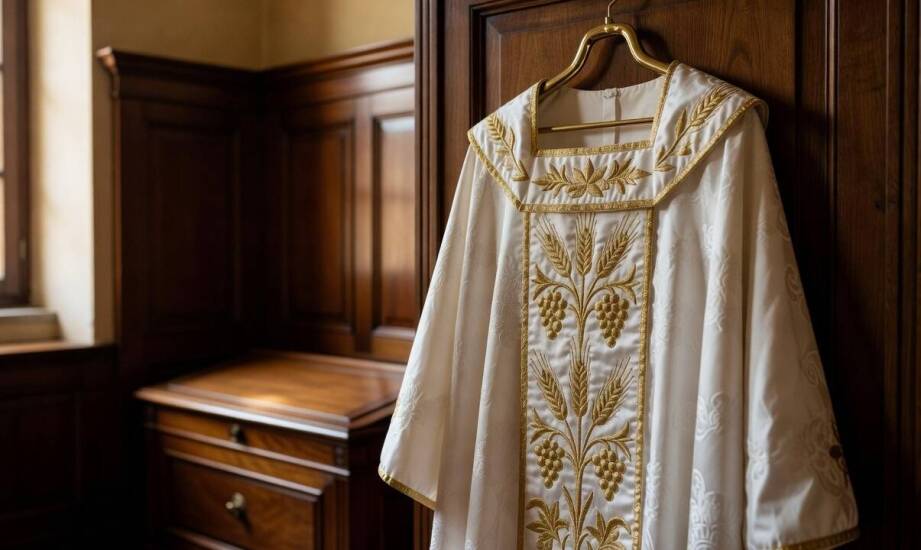
The Roman cut of liturgical vestments is distinguished by its reduced side panels, which leave the forearms largely unobstructed. The evolution from a wide, flowing garment to a form that sits closer to the body was primarily driven by practical needs during the celebration of the liturgy. From the late Middle Ages onwards, richly decorated fabrics such as damask, brocade woven with metallic threads and heavy velvet became increasingly common, influencing the development of chasuble design. Dense embroidery made with metallic thread often restricted arm movement during key moments of the Mass. Gradually narrowing the sides reduced resistance and allowed freer movement of the arms upward, outward and forward.
Regional Variations of the Roman Cut and Their Symbolism
The most important regional adaptations developed between the 18th and 19th centuries, when decorative layouts were adjusted to local liturgical customs in various European dioceses. Both liturgical literature and tailoring tradition recognise several regional forms of the Roman chasuble.
The Italian variant is characterised by a relatively broad back that descends gently without sharp angles. The front covers most of the chest and a significant portion of the shoulders. Its hallmark decorative element is the T-shaped orphrey on the front of the vestment, combined with a single prominent column on the back. The wider shoulder section improves stability and helps the garment remain properly positioned during lengthy Eucharistic processions. Workshops such as Ars Sacra continue to recreate this historic form for customers around the world.
The French variant features a noticeably narrower back and a more angular front section that exposes a greater portion of the upper chest and shoulders. It is commonly finished with a Parisian cross or a traditional Latin cross embroidered on the back, reversing the decorative proportions often associated with Italian models. The reduced fabric around the upper torso allows greater freedom for frequent liturgical gestures. This style is frequently complemented by stoles with spade-shaped ends decorated with dense fringes.
The Spanish variation is often regarded as the most distinctive version within the family of Western liturgical vestments. This cut significantly reduces the amount of fabric around the shoulders and arms, creating the profile commonly referred to as a fiddleback chasuble. The narrow waistline traditionally encouraged the use of elaborate column-style embroidery, highlighting symmetrical decorative details. The Austrian variation, by contrast, is distinguished by soft, rounded edges at both the front and back. Wider decorative trims and the absence of sharp angles create a flowing silhouette.
Practical Examples and Fabric Care
Today, the Roman chasuble is available in several distinctive forms, each suited to different levels of liturgical solemnity.
One of the most widely used versions is the classic fiddleback model made from structured jacquard fabric, finished with broad gold trims along the outer edges. This design offers excellent freedom of movement while requiring internal reinforcement to maintain its characteristic shape during movement around the altar.
There are also Marian Roman chasubles decorated with blue motifs or produced in shades of blue. It should be noted, however, that blue is not among the standard liturgical colours in most of the Latin Church. Its use is generally associated with specific liturgical privileges or traditions connected with devotion to the Immaculate Conception of the Blessed Virgin Mary.
For major feast days and particularly solemn celebrations, broader Italian-style models are often preferred. Rich fabrics serve as the base for elaborate embroidered crosses, while the large decorative back panel allows theological symbolism to remain clearly visible even from the rear rows of the nave.
The complexity of these vestments requires careful maintenance methods that differ significantly from standard garment care. Cleaning procedures should always follow the manufacturer's recommendations and the characteristics of the particular fabric used. Many textiles permit professional specialist cleaning, while historic vestments or garments featuring raised metallic-thread embroidery may require only limited spot cleaning using appropriate conservation methods.
Proper storage of heavier liturgical vestments helps reduce stress on internal structural layers. Gold thread, decorative trims and dyed damask fabrics may gradually fade when exposed to prolonged sunlight. For this reason, valuable vestments are best stored in breathable cotton garment covers. Despite centuries of stylistic evolution, the traditional Roman cut remains an important and respected element of the Catholic Church's liturgical heritage.
FAQ
What distinguishes a Roman chasuble?
A Roman chasuble, often called a fiddleback chasuble, features significantly narrowed sides and a more compact structure than a Gothic chasuble. This design allows greater freedom of arm movement while showcasing decorative embroidery more prominently.
Is the Roman chasuble older than the Gothic chasuble?
No. Early chasubles were generally fuller in shape and closer to what later became known as the Gothic form. The Roman cut developed gradually through modifications to these earlier garments.
When are Roman chasubles most commonly used?
They are frequently used during solemn celebrations, liturgies associated with older traditions and in churches that preserve historic ceremonial forms.
What decorations are most common on Roman chasubles?
Typical decorative motifs include:
Latin crosses
Parisian crosses
Embroidered back columns
The IHS Christogram
Eucharistic symbols
Marian motifs
Is the Roman chasuble permitted under current liturgical regulations?
Yes. The Roman chasuble remains a fully legitimate liturgical vestment within the Catholic Church, just like the Gothic chasuble.
What is the main difference between Roman and Gothic chasubles?
The primary difference lies in their construction. A Gothic chasuble is wider and drapes generously over the sides, whereas a Roman chasuble has narrowed sides and a more structured silhouette. This emphasises vertical decorative elements and facilitates liturgical gestures.
You might be interested

Ceramic mugs as a symbol of Polish tradition and innovation in craftsmanship
Ceramic tableware reflects the richness of Polish culture, combining artisanal tradition with modern solutions. In this article, we will discuss the history of these objects, manufacturing techniques, and their significance in daily life and rituals. We will also explore the influence of local cultu